
Other People's Flowers
26th Aug –
20th Sep
2026

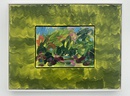
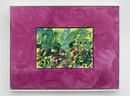
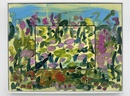
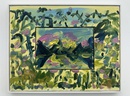
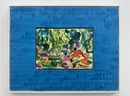
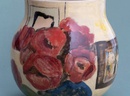
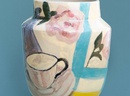
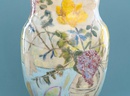
Installation.


KARANGAHAPE ART WEEKEND
18-20 September
Kirstin Carlin & Gavin Hurley in conversation with gallery director Melanie Roger
Sunday, 20 September, 11am
Extended opening hours for KARANGAHAPE ART WEEKEND are:
Friday 5-9pm
Saturday 11 - 3pm
Sunday 11 - 3pm
Full programme and downloadable map - https://www.karangahaperoad.com/karangahape-art-weekend
In Other People’s Flowers, Kirstin Carlin, Julia Holderness and Gavin Hurley turn to the language of flowers to speak both with and through the history of New Zealand art. The exhibition takes its title from the act of gathering what already exists—motifs, compositions and gestures—and re-presenting them not as imitation, but as a form of attentive response. Flowers become intermediaries: symbols of homage, translation and quiet disruption.
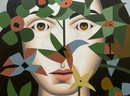
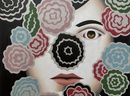
Hurley’s practice has long been grounded in portraiture and the codes of representation embedded in art history. In this exhibition, the figure remains, but is partially obscured—interrupted by blooms that drift across the surface of the painting. Faces are veiled and identities made uncertain. These flowers do not simply decorate; they complicate. They act as both screen and signal, exposing the portrait as constructed while withholding it from full view. In responding to art-historical precedents, Hurley layers his subjects with floral forms that echo the compositional weight of earlier works, suggesting that depiction is always entangled with what has come before.
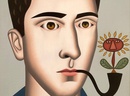
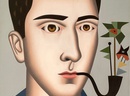
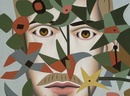
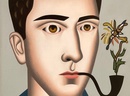
A second series features a young male figure smoking a pipe. Each work incorporates a flower drawn from art history: a chrysanthemum from Gordon Walters, a smiling flower from Michael Illingworth, and the abstracted flowers from Louise Henderson’s The Persian Paper Toy Seller (1957) These flowers bring fragments of Aotearoa’s visual history into Hurley’s enigmatic portraits. The pipe adds another layer of ambiguity. Familiar from the visual language of Surrealism, it also evokes the conventions of colonial portraiture and European masculinity—leisure, civility and cultivated taste. In Hurley’s hands, these familiar codes become subtly strange. The young figure seems caught between the recognisable language of portraiture and something more psychologically elusive. Together, the pipe and borrowed flowers bring European, colonial and local art histories into the same image, creating a portrait as much concerned with inherited images and identities as with the figure himself.
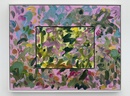
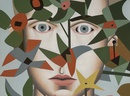
Kirstin Carlin’s work, by contrast, leans into materiality and gesture. Her floral forms are looser and more provisional, hovering between recognition and abstraction. Where Hurley’s paintings retain the structure of portraiture, Carlin tests how far an image can drift from its source while still carrying its trace. Her flowers do not simply quote their sources; they metabolise them. Paint becomes a site where art history is broken down and reassembled into something at once familiar and estranged.
Flowers and gardens recur throughout Carlin’s practice. She borrows, collects and reworks imagery from gardens, still lifes, photographs, paintings and memory, trawling online collections and building an expansive archive from which her paintings emerge. For this exhibition, the flowers and gardens of Frances Hodgkins, Doris Lusk and Joanna Margaret Paul are particularly present in her thinking.
Carlin also pushes at the idea of the frame. The new paintings incorporate cut-out elements that the artist has moved, rearranged and remixed. A central painting might sit within a field of colour or appear within another painting. The frame becomes less a boundary than a space of possibility. Her paintings are rooted in what she calls “other people’s flowers”: images gathered through sustained looking and transformed through experimentation, layering and the physical act of painting.
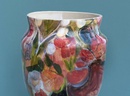
Julia Holderness revisits a body of work first developed for The Studio, an exhibition presented at Dunedin Public Art Gallery in 2021. That project explored the shared studio of three young New Zealand artists—Doris Lusk, Anne Hamblett and Molly Lawn—who rented a space and worked together in central Ōtepoti Dunedin in the years following art school, 1939–40. Flowers were a recurring presence in the shared studio: gathered, arranged, painted, and returned to as subjects of observation and conversation.
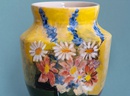
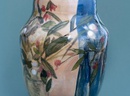
For Other People’s Flowers, Holderness revisits paintings by Hamblett and Lusk from this period through a series of vase works that draw upon their still-life compositions, including the flowers and textiles depicted within them. Through close looking, reinterpretation and response, Holderness considers friendship, influence and the generative possibilities of shared creative practice across time. Her works transform the domestic still life into a site of exchange, where one artist’s looking becomes another artist’s starting point.
Together, the three artists approach New Zealand art history not as a fixed canon but as a living ecology—one that can be pruned, grafted and made to flower again. The works draw on familiar images and compositional strategies, yet resist direct citation. Instead, they operate through echo and displacement.
The exhibition invites viewers into a process of recognition that is never fully resolved. There is a sense that these images have been encountered before, but they remain just out of reach. This slippage is central to the project. By obscuring, abstracting, borrowing and reconstructing through flowers, Carlin, Holderness and Hurley open a space between visibility and invention, asking what it means to inherit an image—and how that inheritance might be both honoured and unsettled.
Here, flowers are not passive symbols of beauty or transience. They are active agents of translation, carrying meanings across time, artists and contexts while reminding us that meaning is never fixed. Removed from one setting and placed in another, a flower can become a gesture of reverence, interruption or renewal.
Other People’s Flowers is ultimately an exhibition about looking again: at images we think we know, at histories we take for granted, and at the layered ways artists continue to speak to one another across generations. It is a conversation conducted through borrowing—not to reproduce the past, but to keep it alive, unsettled and open to new possibilities.
Image: Gavin Hurley, 'Big Sonia with Henderson's Flowers', 2026, oil on linen, 1000 x 800 mm
Julia Holderness exhibits courtesy of Sanderson Gallery where her exhibition 'Botanical Correspondents' will run concurrently from 26 August - 14 September.