
Nadia Marychurch
Āe, Hine
28th Oct –
21st Nov
2026
OPENING EVENT: Wednesday, 28 October, 5.30-7.30pm
A new solo presentation by Nadia Marychurch (Ngāi Te Rangi, Ngāti Raukawa) - her first time exhibiting with Melanie Roger Gallery.
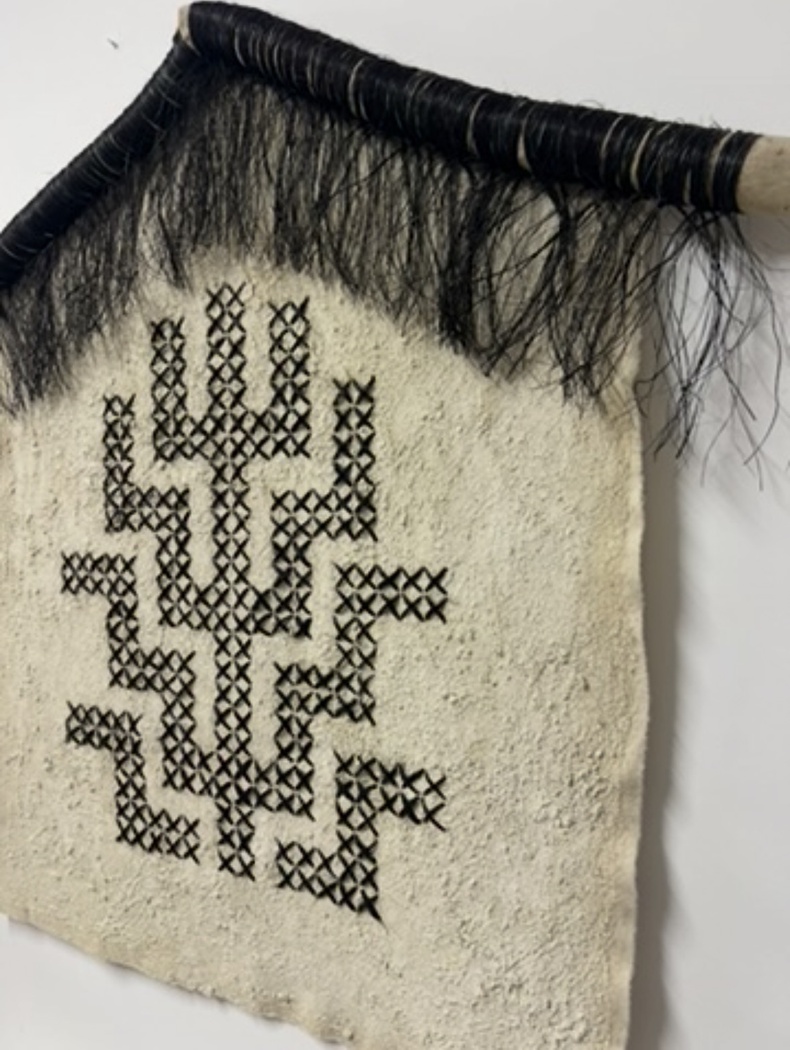
This new exhibition follows on from her sold-out solo presentation at the 2026 Aotearoa Art Fair as part of the Horizons sector, curated by Becky Hemus - publisher and editor-in-chief of Current art magazine. The presentation, titled 'He Haerenga Whenua', featured works created from reclaimed wool blankets coated with whenua and stitched with muka into contemporary tukutuku-inspired forms, alongside driftwood and hand-formed uku gathered from Matakana Island.
"These works are concerned with the things we have been taught to separate: light and dark, Māori and Pākehā, life and death, belonging and unbelonging, the sacred and the ordinary. They ask what happens when we refuse those divisions — when darkness is understood not as the absence of light, but as something necessary to the whole.
I work with whenua, uku, onepū, muka and repurposed woollen blankets — materials that carry their own histories and resist being entirely controlled. I am interested in what happens when these materials meet: when black sits against white, when something is bound and stitched back together, when what has been discarded is given another life.
Āe, Hine draws on the pūrākau of Hinetītama and Hine-nui-te-pō, and the profound movement between these states of being. I am drawn to Hine not as two separate figures, but as one wahine whose story contains transformation, rupture, darkness, guardianship and continuity.
This has become a way for me to think about my own experiences of identity and the ways people are categorised. Growing up, I was described as “half caste” — a language that divided a person according to blood and placed value on which side of a line they belonged to. I now understand that language as part of a much larger history of attempting to make Māori identity measurable, divisible and containable.
My work asks what happens when we refuse that division.
Black and white do not need to cancel each other out. Darkness does not make light less whole. The night is not an absence of day, nor is grief an absence of life. There are seasons of darkness that are necessary, generative and deeply human.
The recent loss of my mother has brought this into sharper focus. I am learning that grief is not something to hurry through in order to return to the light. It is part of love. It belongs to a life fully lived.
In Āe, Hine, I am interested in the space where opposites meet — not to resolve them, but to allow them to exist together.
I am not interested in being half.
I am interested in being whole."