
Martin Poppelwell
Bio.
Martin Poppelwell (born 1969) is a contemporary New Zealand artist whose multidisciplinary practice spans painting, ceramics, sculpture, and installation. Based in Hawke’s Bay, he has been active since the early 1990s, developing a distinctive visual language that merges abstraction, text, and object-making into layered, process-driven works.
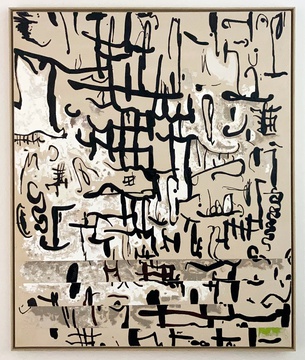
Educated at the Elam School of Fine Arts at the University of Auckland, Poppelwell has exhibited widely throughout Aotearoa New Zealand and Australasia, building a reputation for a practice that resists easy categorisation. He moves fluidly between media, often treating painting, pottery, and constructed objects as interconnected components of a broader conceptual system. His work frequently incorporates fragments of language, references to literature, and echoes of art history, forming networks of ideas that unfold across surfaces and forms.
A defining aspect of Poppelwell’s practice is his engagement with literary sources, particularly the work of Samuel Beckett. Beckett’s pared-back, cyclical, and often unresolved narratives resonate strongly with Poppelwell’s interest in repetition, ambiguity, and the instability of meaning. Rather than illustrating literary texts, he draws on their structural qualities—ellipsis, fragmentation, and rhythm—embedding them within visual compositions that suggest both construction and erasure. Partial words, repeated motifs, and interrupted patterns appear across his work, creating a quiet tension between coherence and breakdown. Alongside this literary engagement, Poppelwell draws on traditions of post-minimalism and conceptual art, weaving subtle art-historical references into his materially focused practice.
This sensitivity to process and material is especially evident in his ceramics. Poppelwell’s pottery is not separate from his painting but an extension of it, translating many of the same concerns into three-dimensional form. His vessels often feature hand-drawn markings, abstracted text, and irregular glazing, emphasising touch, imperfection, and the temporality of making. Like his paintings, these works balance structure and disruption: forms may appear functional at first glance, yet they are subtly destabilised through asymmetry, surface variation, or unexpected visual interruptions. The ceramics foreground the physicality of clay while maintaining a dialogue with the graphic and conceptual elements that underpin his wider practice.
Across all media, a recurring concern in Poppelwell’s work is the tension between order and irregularity. Grids, patterns, and modular arrangements frequently underpin his compositions, but they are disrupted—unevenly drawn, partially obscured, or allowed to dissolve—emphasising process and the passage of time. This interplay produces works that feel at once deliberate and provisional, inviting sustained attention and open interpretation.
Collaboration has also been an important thread within his practice. Poppelwell has worked alongside a number of notable New Zealand artists, including Max Gimblett, Dick Frizzell, Sam Mitchell, et al and Gavin Hurley, among others. These collaborations often operate as extensions of his interest in systems and exchange, allowing for shared authorship, dialogue, and the layering of distinct visual languages. Rather than fixed outcomes, such projects tend to emphasise process, improvisation, and the productive tension between different artistic approaches.
Poppelwell’s work is held in important public and private collections, including Museum of New Zealand Te Papa Tongarewa, MTG Hawke's Bay, and The Arts House Trust.
Across more than three decades, Martin Poppelwell has developed a practice defined by experimentation, material sensitivity, and conceptual layering. Whether working with paint, clay, or constructed forms, he treats each work as part of a larger, evolving system—one shaped by language, memory, literature, and art history. His integration of literary influence, particularly from Beckett, together with an ongoing commitment to both painting and pottery and a collaborative ethos, situates his work within a broader intellectual and material conversation while maintaining a distinctly personal and exploratory approach.
Selected Media.
-
A Storage Problem
Kim Paton, Objectspace exhibition catalogue
2016 -
MARTIN POPPELWELL discusses his ceramic practise
Vimeo, Melanie Roger Gallery
2015 -
KISS THE MOON
Martin Poppelwell, exhibition catalogue
2012 -
NOW WHAT
Lucy Hammonds, exhibition catalogue
2012 -
INTERVIEW WITH MARTIN POPPELWELL
Te Papa Tongarewa, Museum of New Zealand
2012 -
DIFFERENT STROKES
Nicole Stock, Urbis
2011 -
AN ARTIST'S PROGRESS
Jeremy Hansen, Home
2011 -
MARTIN POPPELWELL: BEING THERE WHEN IT HAPPENS
Richard Wolfe, Artists at Work, Random House
2010 -
A FINE LINE
Douglas Lloyd Jenkins, Home
2009 -
OBJECT IMAGE
Aaron Watson, Art Zone
2005 -
LAUGHING MATTER
Mary Shanahan, Urbis
2001
Exhibitions.
-
Painting & Drawing
26th Feb – 21st Mar 2025 -
Fitts, Hurley & Poppelwell
28th Aug – 14th Sep 2024 -
Giddy Up
10th May – 2nd Jun 2023 -
Selected
9th Mar – 2nd Apr 2022 -
bababababa....
29th Sep – 25th Oct 2021 -
Summer Stockroom
2nd Dec – 19th Dec 2020 -
meaninglessnessless
25th Aug – 19th Sep 2020 -
Group Exhibition
24th Jul – 17th Aug 2019 -
Lost to the Horizon
10th Oct – 3rd Nov 2018 -
Painting
19th Jul – 12th Aug 2017 -
Auckland Art Fair | Booth B1
25th May – 29th May 2016 -
Bluff
9th Mar – 2nd Apr 2016 -
Summer
24th Nov – 19th Dec 2015 -
Group Show
1st Jul – 25th Jul 2015 -
Summer Paper Round
19th Nov – 20th Dec 2014 -
post hole
12th Mar – 5th Apr 2014 -
Summer
27th Nov – 20th Dec 2013
News.
- Martin Poppelwell | Studio Visit
- Martin Poppelwell | The Good Oil podcast
- AAF Studio Visit: Martin Poppelwell
- Studio Visit: Martin Poppelwell
- Studio Visit: Martin Poppelwell
- Martin Poppelwell | Unravelled | City Gallery, Wellington
- Stockroom at Sapphire | Part of Artweek Auckland
- Artweek Auckland | Sam Mitchell & Martin Poppelwell
- Martin Poppelwell | East | Hastings City Art Gallery
- Martin Poppelwell | Index | Waikato Museum of Art and History
- Martin Poppelwell | Index | Hastings City Art Gallery
- White Night | Auckland Festival 2016
- MARTIN POPPELWELL | A Storage Problem | Objectspace as part of Auckland Festival
- Martin Poppelwell | Empire of Dirt | Objectspace
- Gallery Vimeo Channel
- Public Programmes | Gavin Hurley & Martin Poppelwell Artist Talks
- Martin Poppelwell & Max Gimblett Collaboration | Workshop
- MARTIN POPPELWELL | Form | Papakura Art Gallery
- Martin Poppelwell publication
- ART NEW ZEALAND Magazine texts
- Martin Poppelwell | High St Mural